Future Food
AI & Data
Semester programme:Artificial Intelligence
Research group:Sustainable Data & AI Application
Project group members:Hanh Ngo Minh Truong
Priyanka Darbari - Project Supervisor
Project description
The main research question of this project is: How can the current AI-driven nutrition system from the previous internship be optimized to influence personalized food habits while promoting sustainable food awareness?
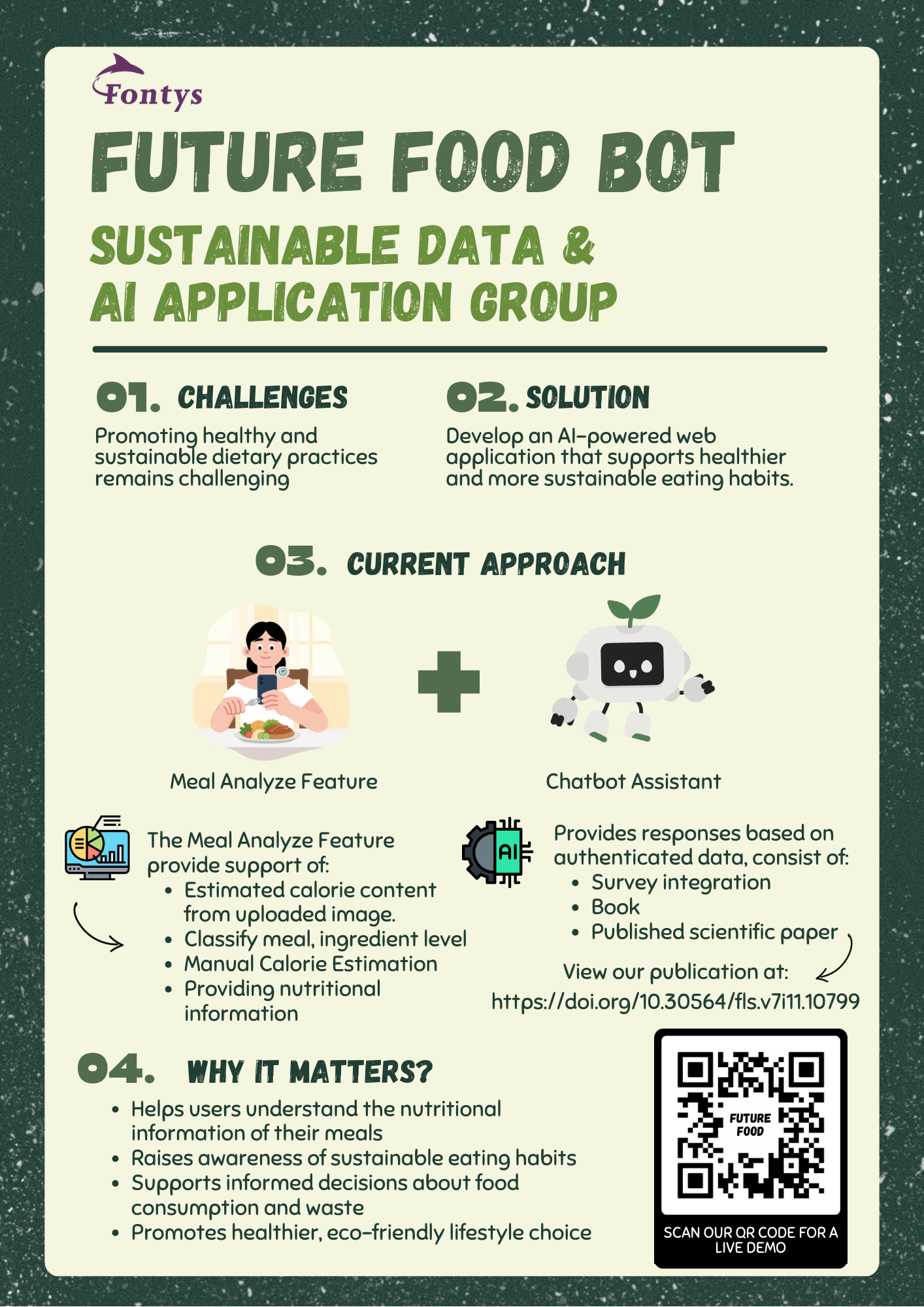
The project builds on an existing AI nutrition system and focuses on improving its effectiveness rather than developing a new solution from scratch. The system consists of two separate components: an AI model that estimates calories and nutritional values from food-related data, and a chatbot that provides nutritional guidance base on validated and authentic data sources. The challenge lies in optimizing how these components support personalization, user engagement, ethical consideration and awareness of sustainable food choices. The project explores how AI-driven insights can better adapt to individual users while encouraging healthier and more sustainable eating habits.
Context
The project is situated in the nutrition and food sustainability domain, focusing on how digital technologies can support healthier and more responsible eating habits. It builds upon an existing AI-driven nutrition system developed during a previous internship and aims to further optimize its impact on user behavior. The project is implemented in the context of a web application that provides accessible and user-friendly interaction for end users.
Core concepts of the project include artificial intelligence, human-centered design, and ethical considerations. AI is used to generate data-driven nutritional insights, while human-centered design ensures that the system adapts to individual user needs, preferences, and understanding. Ethical considerations play an important role in addressing issues such as transparency, fairness, data privacy, and responsible use of AI in influencing food-related decisions.
In addition to personal nutrition, the project emphasizes food sustainability, encouraging users to become more aware of their dietary choices. By combining nutrition guidance with sustainability awareness, the system aims to support informed decision-making that benefits both individual health and society.
Overall, the project lies at the intersection of nutrition technology, sustainable food systems, and ethical AI, demonstrating how AI-powered web applications can responsibly influence food habits while maintaining a strong focus on user well-being and societal values.
Results
The project delivers both tangible products and valuable insights that contribute to the nutrition and food sustainability domain. The primary product is an AI-driven web application consisting of two core components: a calorie and nutrition prediction model, and an AI-powered chatbot. Although these components function independently, they complement each other by providing data-driven insights and personalized guidance to users.
The nutrition prediction model combines food classification with calorie estimation to generate meaningful nutritional insights from food-related input. By linking food recognition with calorie prediction, the model provides users with a clearer understanding of the nutritional value of their meals. Validation was performed by comparing predicted results with reference nutritional data, demonstrating that the model is capable of producing consistent and practically useful outputs. This component reaches approximately TRL 4–5, as it has been validated in a controlled development environment and tested with representative data.
The chatbot is designed to provide reliable and responsible nutritional guidance. Unlike generic conversational systems, it bases its responses on authentic and verifiable data sources, including published scientific research papers, books, and manually collected survey data gathered as part of the project. This approach increases transparency and trustworthiness, which is especially important in a health-related context. Validation included scenario-based testing and expert-informed review of chatbot responses, confirming that the information provided is accurate, relevant, and ethically appropriate. The chatbot aligns with TRL 5–6, as it has been demonstrated in a realistic web application setting.
Beyond the technical products, the project generates important insights into how AI systems can influence food-related decision-making. The results show that combining explainable nutritional predictions with evidence-based conversational guidance can enhance user awareness of both health and sustainability aspects. Furthermore, the integration of ethical considerations, such as data transparency and responsible AI use, adds long-term value by supporting user trust and informed choices.
Overall, the project demonstrates a validated, ethically grounded AI solution with clear practical value, positioned at an intermediate TRL level, suitable for further refinement and real-world deployment.