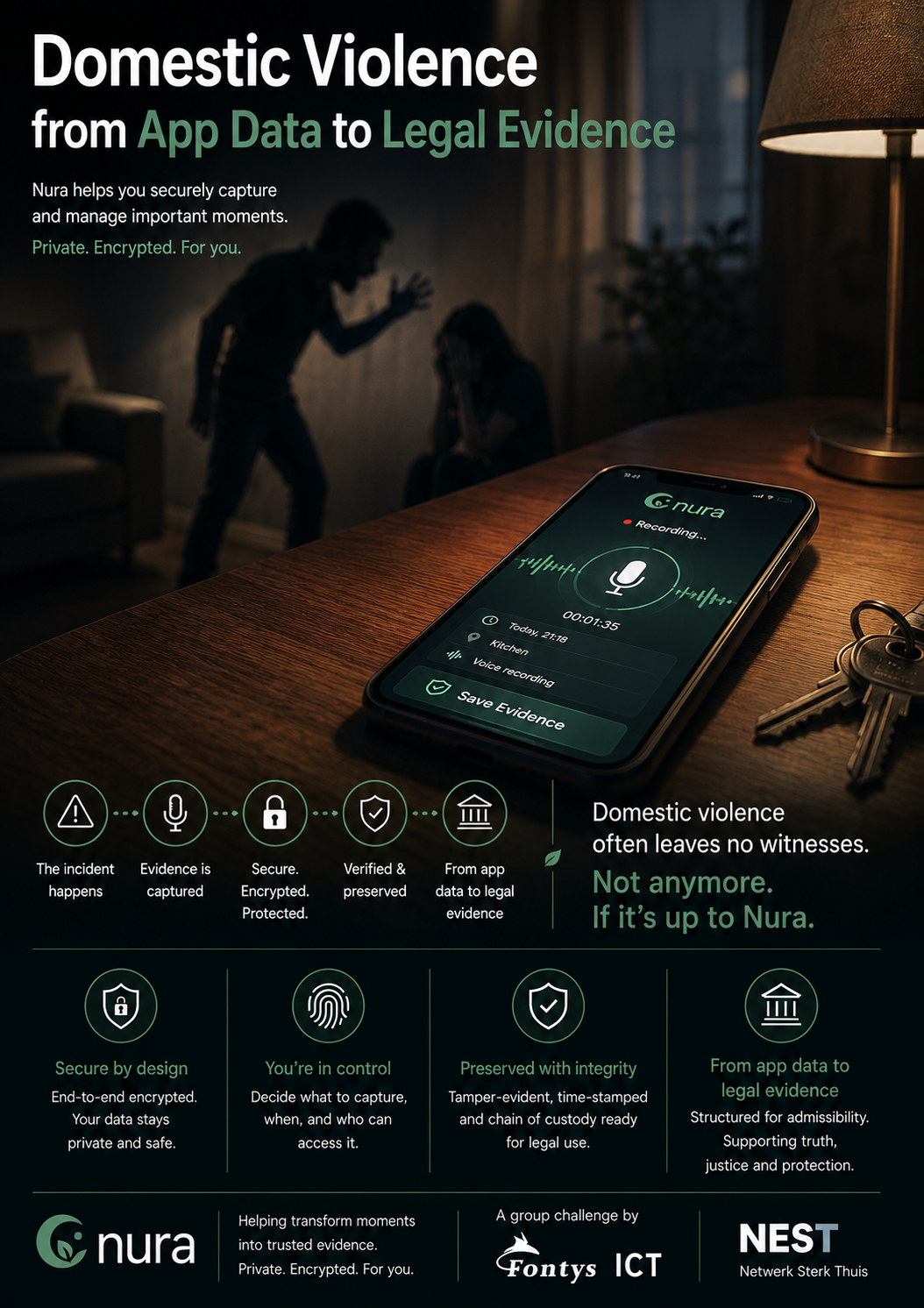
Domestic Violence: From App Data to Legal Evidence
Cyber Security
Semester programme:Open Learning - Advanced
Client company:Netwerk Sterk Thuis (NEST) an initative of Lumens
Project group members:Maurice Schippers
Thijs Evers
Thijs van de Weijer
Maxim Nabers
Elías Alarcón Guillén
Junior Alegre Zegarra
Project description
How can domestic violence be recorded in an app in a way that meets legal requirements and allows the data to be used as legal evidence?
Context
This project is situated in the domain of social safety and legal technology, with overlap in social care, privacy, cybersecurity and digital evidence. The project focuses on domestic violence, where incidents often happen in private and are difficult to document in a safe, timely and credible way.
The app concept, currently called Nura, explores how victims can record incidents safely while protecting their privacy and personal safety.
Because the target group is vulnerable, the app must be discreet, low-friction and trauma-informed. It should not leave obvious traces through its interface or notifications. At the same time, the collected data must be reliable and easy to assess for professional end-users such as lawyers, police and judges.
The core design challenge is therefore balancing victim safety, GDPR/AVG compliance, technical security, evidence integrity and legal usefulness. The project mainly focuses on app-based documentation, especially audio evidence. This audio evidence is combined with relevant metadata, stored securely, protected through chain-of-custody measures, and presented through an evidence export for professional or legal review.
Results
The main result of the project is a researched and partly prototyped concept for a domestic violence evidence app, supported by legal, technical and stakeholder analyses. The most important insight is that app data cannot automatically be treated as legal evidence. For the data to have evidentiary value, the system must support authenticity, integrity, traceability, privacy and safe use from the design phase onward.
Three key insights shaped the project.
First, evidentiary standards differ between civil and criminal proceedings. Civil cases allow more flexibility, whereas criminal cases require stricter validation of authenticity and reliability. When app-based evidence is presented in a clear and accessible format, it can better support legal assessment, especially in civil proceedings. This led to the inclusion of transcriptions alongside original audio recordings in the generated report, improving accessibility while preserving the source material.
Second, user safety depends on the app leaving no visible traces of use. Any indication of the app could increase risk for the victim. This led to discreet and safety-oriented design decisions, including a discreet app shell that presents the application as a neutral, mundane tool, and the option to disguise or change the app icon to reduce the chance of discovery by a perpetrator.
Third, both victims and perpetrators may attempt to manipulate evidence. Therefore, the system must actively limit opportunities for tampering and make any manipulation detectable. This led to the decision that evidence can only be created through in-app recordings, not manual uploads, strengthening the chain of custody.
Together, these insights shaped the Nura app concept and prototype direction. This supports the legal assessment of evidence, but does not guarantee court admissibility on its own.
The project is currently positioned around TRL 4. The concept and core technical mechanisms have been validated in a controlled prototype and through expert feedback, but not yet in a real operational environment with actual users, police or courts. It is not yet TRL 5 or 6, because safe-word activation, background audio feasibility, real legal validation, usability testing with the target group and full security testing still need to be completed. The value of the project lies in providing a realistic bridge between victim-centred design and legally useful digital evidence.