The Dispersed Project

Project description
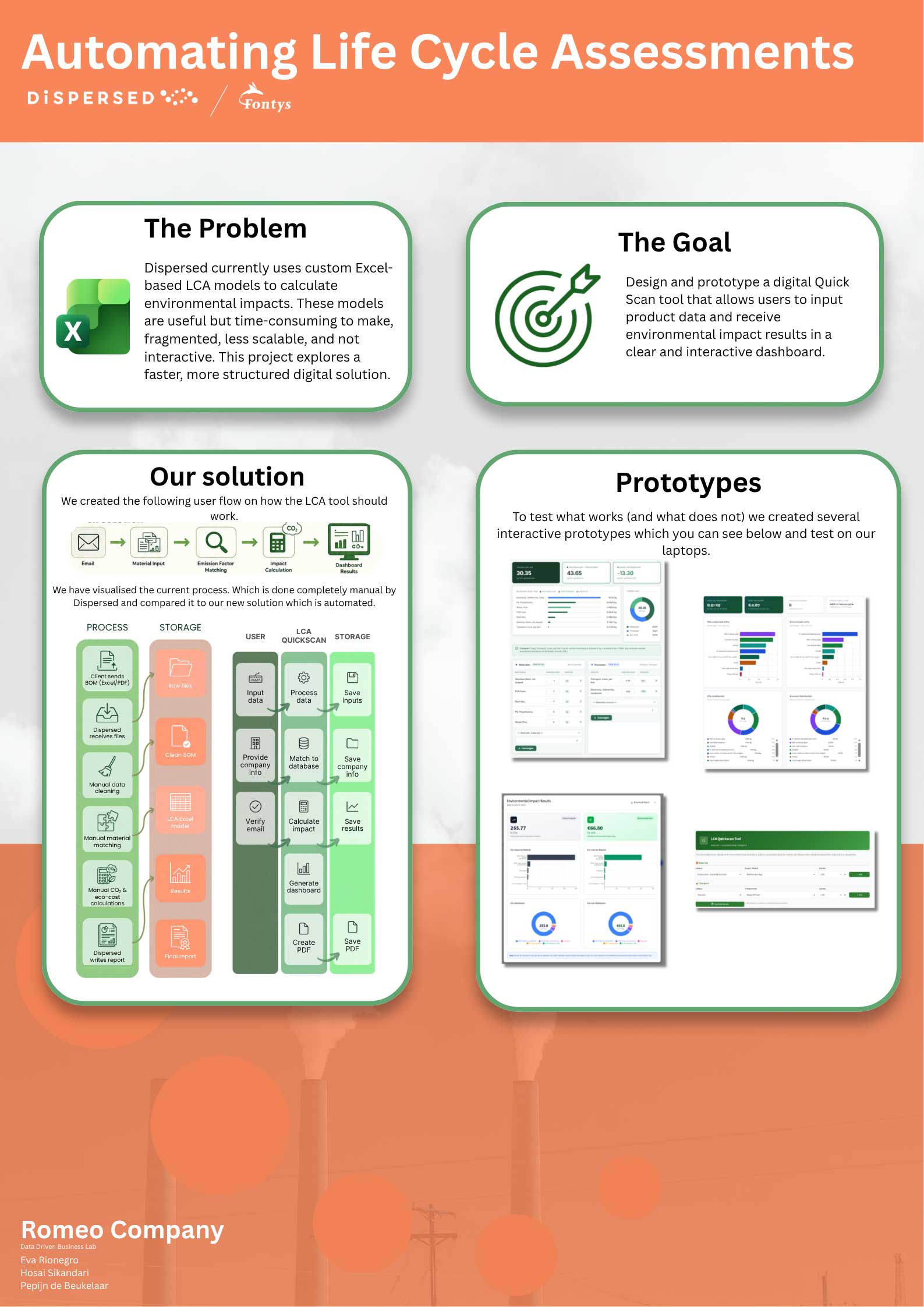
The main challenge of this project was to help Dispersed improve the accessibility and efficiency of Life Cycle Assessments (LCAs). The project focused on designing and developing a digital LCA Quick Scan Tool that allows users to quickly estimate the environmental impact of a product based on material, manufacturing, and transport data.
Context
This project was carried out in the sustainability and environmental impact assessment domain. Dispersed helps organizations measure and reduce the environmental impact of products and processes using Life Cycle Assessments (LCAs). However, performing a full LCA can be complex, time-consuming, and requires specialized knowledge.
To address this challenge, the project focused on developing a digital LCA Quick Scan Tool that allows users to quickly estimate environmental impacts based on material, manufacturing, and transport data. The tool uses data from the Idemat database to calculate CO₂ emissions and eco-costs. In addition, a Power BI dashboard was developed to help Dispersed analyze how the tool is being used, identify trends in user input, and gain insights into the environmental impacts calculated through the tool.
The project combines sustainability, data analysis, business intelligence, and software development to support more accessible environmental decision-making.
Results
The most important outcome of this project was the development of a working digital LCA Quick Scan Tool for Dispersed. The tool allows users to quickly estimate the environmental impact of a product based on material, manufacturing, and transport data, resulting in calculated CO₂ emissions and eco-costs. This significantly improves accessibility compared to traditional LCA methods, which are often time-consuming and require specialist knowledge.
A second important outcome was the development of a Power BI dashboard. The dashboard enables Dispersed to monitor how the tool is used, identify trends in user inputs, and gain insights into the environmental impacts being calculated. This provides valuable information for further development of the tool and supports data-driven decision-making.