Citizen City
AI & Data
Semester programme:Strategic Information & Data Architectures
Client company:Citizencity and Municipality of Eindhoven
Project group members:Bo Hofland
Rick van Esch
Daniel Sanchez Morales
Nick van Heugten
Tsvetan Hristov
Lotte de Haan
Project description
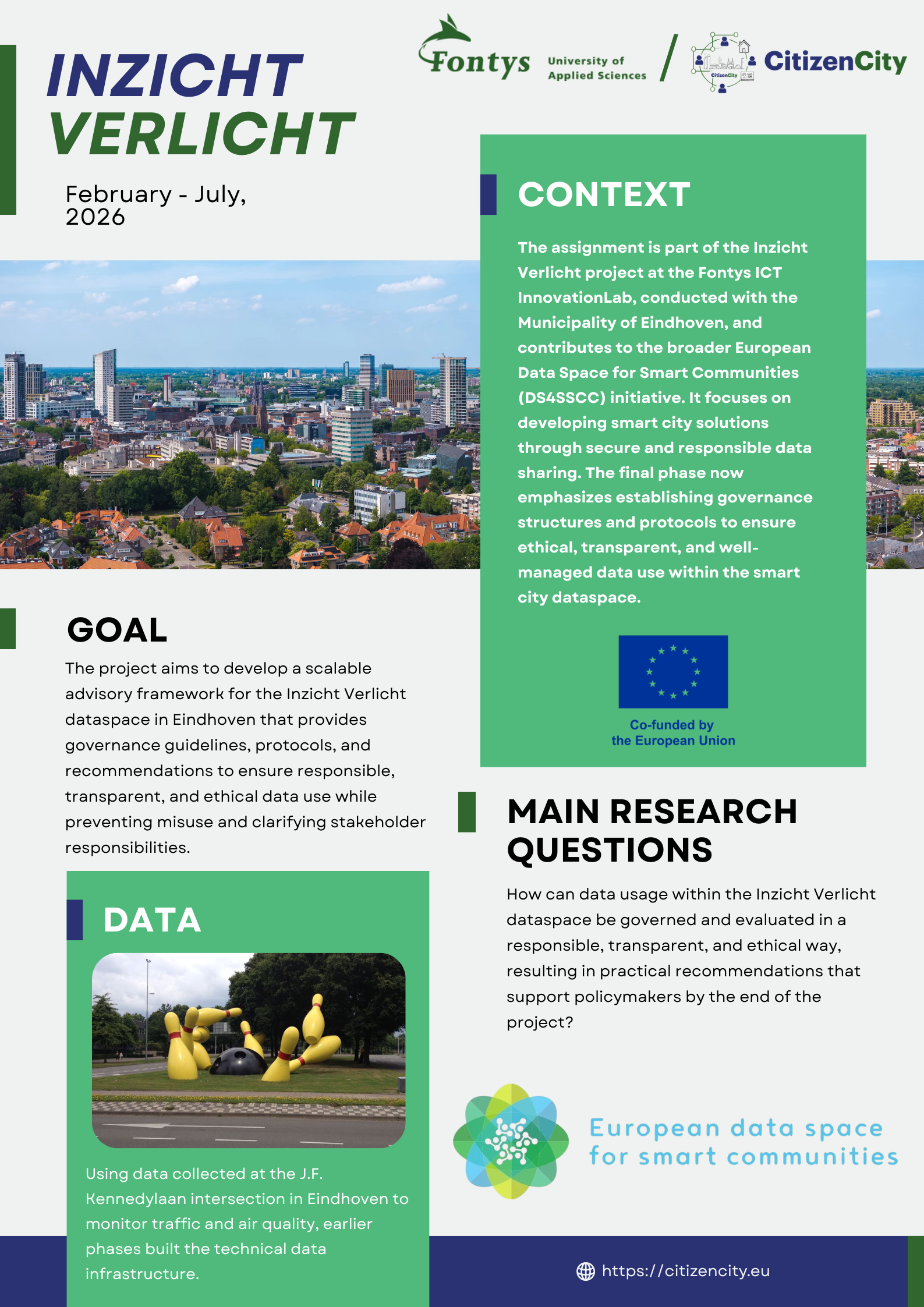
Within the Inzicht Verlicht dataspace can data usage be governed and evaluated in a responisble, transparent, and ethical way, resulting in practical recommendations that support policymakers.
Context
This research document examines data governance in the Inzicht Verlicht smart city dataspace, a project centered on traffic and air-quality sensors at the J.F. Kennedylaan intersection in Eindhoven, Netherlands, under the broader CitizenCity initiative.
The domain sits at the intersection of smart city technology, data governance, and digital ethics. The core concern is how sensor data on mobility and environment can be shared and used responsibly, transparently, and ethically, with Eindhoven's municipality acting as both data holder and primary beneficiary, raising conflict-of-interest questions around oversight.
Key themes include privacy and re-identification risk, GDPR and EU regulatory compliance (including the Data Governance Act and Data Act), accountability gaps, and the lack of a clear governance structure with defined roles.
The work also references established frameworks such as ISO 27001, NIST, the International Data Spaces Association, and GAIA-X.
Methodologically, the research combines literature review, document analysis of prior deliverables, stakeholder interviews and workshops, and co-creation sessions, aiming to produce practical governance recommendations for policymakers managing this real-world smart city dataspace.
Results
The document builds a governance framework for Inzicht Verlicht, closing six identified gaps: undefined roles, no audit trails, no ethics review, no re-identification checks, the municipality's conflict of interest as both data holder and user, and no enforcement.
It defines clear roles, a three-tier agreement structure, access policies for open and restricted data, monitoring and audits, and a mandatory ALTAI-based ethics review with citizen input channels. A seven-dimension KPI framework makes the commitments measurable.
Two business cases show the framework resolving the municipality's dual role and preventing mission creep. It ends with a three-phase roadmap and eight prioritized recommendations, starting with formally establishing a Governance Authority within three months.
About the project group
We are a fun group with a lot of different personalities. We spent a lot of time on this project, mostly doing research. You can any of us question about the project, we would love to help you.